
Employee Engagement: Building Commitment, Ownership, and Energy at Work

Employee Engagement: Building Commitment, Ownership, and Energy at Work
Employee engagement shapes how work feels, how energy flows, and how results are sustained over time. It reflects the level of commitment people bring to their role, their team, and the organization as a whole. When engagement is strong, people contribute with intention and ownership. When it declines, effort becomes transactional, and connection fades. In the end, when it goes unchecked, if they stay, you get left with skepticism and apathy.
Engagement is often discussed as a score or survey result. In reality, it is a lived experience that shifts over time based on leadership behavior, clarity, feedback, and trust. This guide reframes engagement as a dynamic lifecycle rather than a static metric, helping leaders recognize where engagement strengthens, where it softens, and how to respond with intention before it's too late.
Why Engagement Feels Harder to Sustain Today
Work has changed faster than leadership habits. Expectations continue to rise around flexibility, personal development, deeper meaning, and personalization. At the same time, many organizations still rely on standardized approaches to communication, development, and recognition.
Standardization makes people feel like a number. The result, engagement weakens and skepticism rises. They feel like they don’t matter and they disconnect from the leaders, the organization and their work. Disconnection drives further apathy, complacency, and distrust. When people feel valued and appreciated, engagement rises.
Engagement as a Lifecycle, Not a Score
Employee engagement unfolds in observable stages. These stages describe how emotionally and cognitively invested someone feels at work, and they provide leaders with early signals long before disengagement shows up in performance reviews or turnover data.
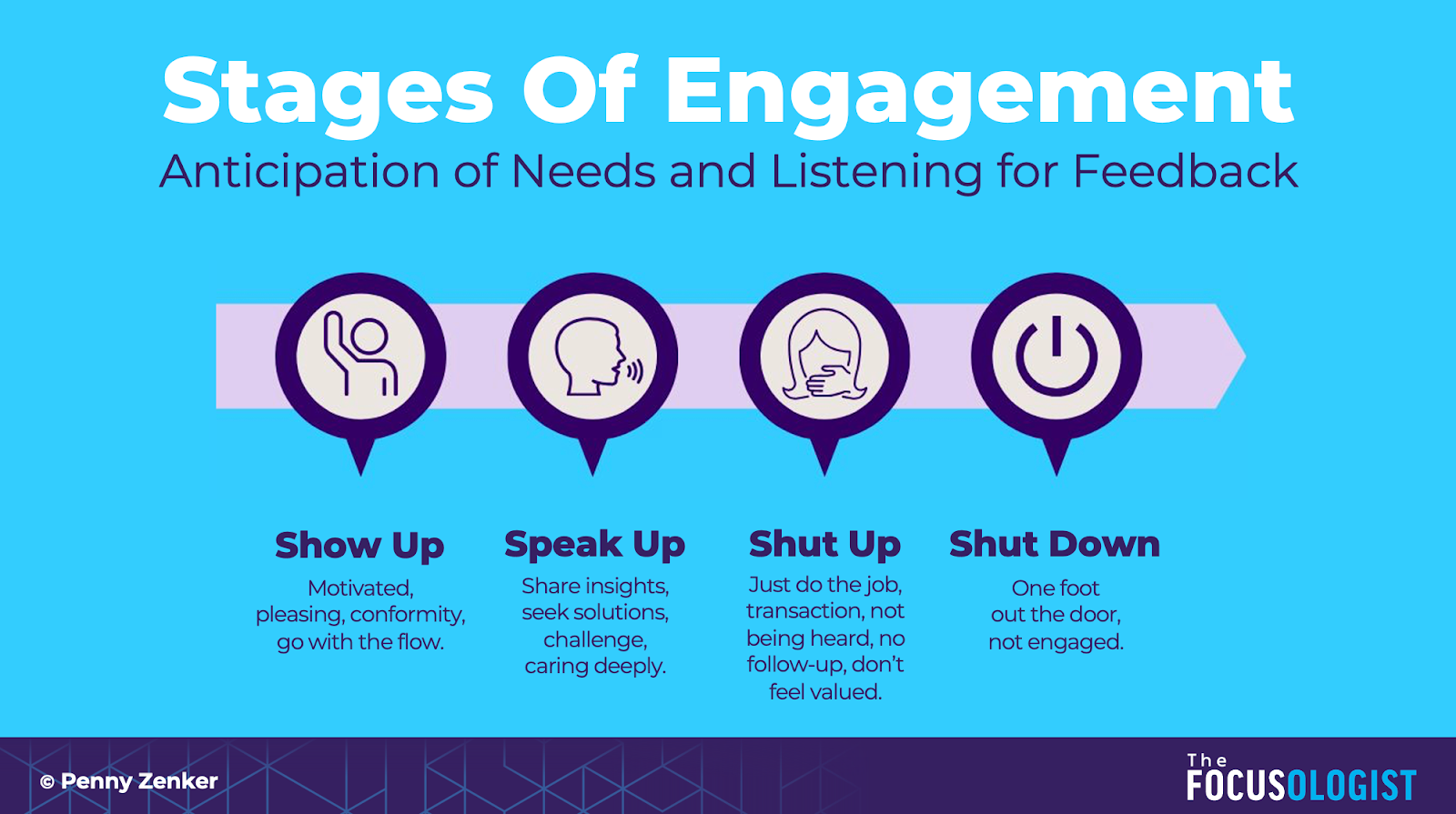
The four stages are:
- Show Up
- Speak Up
- Shut Up
- Shut Down
Each stage reflects a different relationship between the employee and the organization, and each requires a different leadership response.
Watch this video of me presenting the stages
Stage One: Show Up
At this stage, employees meet expectations and follow established processes. They are present, cooperative, and reliable. Energy remains steady and contained. People contribute without pushing edges or creating friction.
From a neuroscience perspective, this stage reflects a regulated nervous system. Predictability supports the brain’s preference for efficiency and stability. Habit loops and procedural memory guide behavior. Trust in structure supports consistency.
Leadership focus at this stage
Engagement strengthens when leaders shape the conditions for contribution early. Clear priorities and role clarity reduce cognitive friction and free mental capacity for higher level thinking. When leaders explain what matters and why, the brain shifts from task execution into meaning making.
Personalization at this stage centers on clarity and access. People need to understand how expectations apply to their role, their context, and their strengths. Consistent signals of respect, fairness, and follow through support psychological safety and belonging. Simple personalization such as adapting communication style, inviting input in familiar ways, and recognizing reliability builds the bridge from participation to ownership.
Stage Two: Speak Up
This stage reflects deep engagement. Employees share insights, ask sharper questions, challenge assumptions, and connect their work to outcomes. Responsibility expands. Investment increases. Energy becomes visible.
Neuroscience shows this as a state of optimal engagement. The prefrontal cortex supports creativity and judgment. Dopamine reinforces initiative. Oxytocin strengthens trust and collaboration.
Leadership focus at this stage
Sustaining engagement here requires consistency and responsiveness. Leaders listen and act. Feedback flows both directions. Recognition remains specific and timely. Growth conversations feel relevant and human.
Personalization at this stage focuses on development and autonomy. People want feedback that reflects their goals, strengths, and aspirations. Tailored stretch opportunities, personalized learning paths, and individualized recognition reinforce motivation and deepen ownership. Engagement stays strong when people feel seen as contributors, not roles.
Stage Three: Shut Up
At this stage, engagement erodes quietly. Work continues while emotional investment fades. Effort becomes transactional. Ideas remain unspoken. Curiosity softens.
This shift often reflects subtle threat activation in the brain. Perceived misalignment or loss of value narrows focus. Energy turns inward as people conserve effort.
Leadership focus at this stage
Re engagement begins with awareness and presence. Leaders benefit from stepping back and noticing behavioral shifts early. Regular check ins restore clarity. Meaningful feedback and acknowledgment reopen dialogue.
Personalization here centers on listening and relevance. People need to feel heard in ways that reflect their communication style and concerns. One size approaches increase distance. Individual conversations that reconnect work to personal values, strengths, and priorities help rebuild trust and engagement.
Stage Four: Shut Down
At this stage, disengagement turns internal. Motivation disappears. Connection dissolves. The individual feels detached from purpose and possibility. Turnover risk peaks.
Neuroscience associates this stage with prolonged stress response. Cognitive capacity narrows. Emotional withdrawal serves as self protection.
Leadership focus at this stage
Recovery begins with honesty and care. Engagement sometimes rebuilds through role clarity, development opportunities, or recalibrated expectations. In other cases, mutual clarity supports a respectful transition.
Personalization at this stage focuses on dignity and choice. People need direct conversations that honor their experience, needs, and capacity. Support options, flexible paths, or clear transitions help restore agency even when engagement cannot be fully rebuilt.
Engagement Across All Stages
Engagement strengthens when leadership adapts to how people think, feel, and contribute at each stage. Personalization supports clarity, trust, and energy by meeting people where they are rather than where leaders expect them to be.
Engagement grows through daily leadership behavior and thoughtful adjustment. It reflects how leadership is experienced in real time and how consistently people feel seen, valued, and supported.
What Drives Engagement Across All Stages
Engagement strengthens when leaders consistently address a few core drivers:
- Clarity around priorities and expectations
- Personalized feedback that is timely and relevant
- Development and recognition that feels personal
- Opportunities for growth and contribution
- Trust built through follow-through
Engagement fades when these drivers weaken.
Check out this podcast
The Role of Reset Moments and Personalization in Engagement
Engagement improves when leaders recognize moments to step back, reassess what is working, and realign styles and behavior. Reset moments allow leaders to interrupt patterns that slowly erode trust and energy.
Resetting engagement does not require large programs. It requires intentional leadership attention at key moments, especially during transitions, feedback conversations, and periods of change
For leaders who want a deeper understanding of how personalization shapes engagement, trust, and performance across these stages, the New Era of Personalization Report offers practical insight grounded in research. The study examines how employees experience personalization at work and where gaps quietly undermine engagement. It also introduces the 11 Touchpoints of the Employee Experience, highlighting the moments where leadership behavior, communication, feedback, and support matter most. These touchpoints reveal where small, intentional shifts create meaningful impact across onboarding, development, recognition, well being, and growth. You can explore the full report and framework here: https://pennyzenker360.com/new-era-of-persoanlization-study/
Engagement, Well-Being, and Support
Sustained engagement depends on emotional and mental capacity. Leaders increasingly carry responsibility for results while navigating complexity, change, and people dynamics.
Access to professional support can help leaders and employees manage stress, regain perspective, and strengthen resilience. Consider working with outside support such as coaches, and other licensed professionals who support emotional well-being in demanding environments.
Want to ask me questions or various coaches and thought leaders? PennyAI and other instructors are available through your fuel.io membership. Try it for free for 7 days.
Affiliate disclosure: If you choose to explore this resource through MyFuel.io, a small commission may be earned. It does not change the cost and supports ongoing research and educational content.
Engagement as a Leadership Practice
Remember engagement grows through daily leadership interactions rather than annual surveys. Leaders who notice engagement shifts early create environments where people want contribute and feel valued for their effort.
Employee engagement remains one of the strongest indicators of organizational health because it reflects how people experience leadership in real time.
Cluster FAQs
1. What is employee engagement in practical terms
Employee engagement reflects how connected, committed, and invested people feel in their work and the organization. It shows up through energy, initiative, ownership, and willingness to contribute beyond basic requirements. Engagement matters because it directly influences performance, retention, and collaboration. When engagement is high, people solve problems and care about outcomes. When it declines, effort becomes transactional even if results initially look stable. The full guide explains how engagement is experienced day to day rather than measured only through surveys.
2. Why does employee engagement decline even when performance looks fine
Engagement often erodes quietly before performance drops. People may still meet expectations while disengaging emotionally and cognitively. This matters because leaders can miss early warning signs and assume everything is working. Over time, silence replaces contribution, and initiative fades. By the time performance declines, trust and motivation are already damaged. The complete resource explains how to recognize engagement shifts early and respond before they become costly.
3. What are the stages of employee engagement
Employee engagement progresses through four observable stages: Show Up, Speak Up, Shut Up, and Shut Down. Each stage reflects a different level of emotional investment and ownership. Understanding these stages matters because leadership actions that work in one stage can fail in another. Treating engagement as a lifecycle helps leaders intervene with precision rather than generic solutions. The full guide details each stage, the signals to watch for, and the leadership behaviors that influence movement between them.
4. Why is “Speak Up” considered the highest engagement stage
Speak Up represents the point where employees feel safe, valued, and responsible for outcomes. People share ideas, challenge assumptions, and connect their work to results. This stage matters because innovation, collaboration, and discretionary effort live here. Without Speak Up, organizations lose insight long before they lose people. Leaders sustain this stage through listening, follow-through, and meaningful feedback. The complete resource explains how to protect this stage once it is reached.
5. How can leaders recognize early signs of disengagement
Early disengagement often appears as reduced input, fewer questions, and quiet compliance. Employees stop offering ideas and limit effort to assigned tasks. This matters because silence is often misread as alignment. Recognizing these signals allows leaders to intervene while trust can still be restored. Engagement rarely collapses suddenly; it fades through small moments of disconnection. The full guide outlines practical indicators leaders can notice in real time.
6. What causes employees to stop speaking up
Employees stop speaking up when they feel unheard, dismissed, or unclear about expectations. Missed follow-through, inconsistent feedback, and lack of recognition accelerate this shift. This matters because Speak Up behavior requires psychological safety and perceived value. When people believe their voice no longer matters, they conserve energy. Leaders influence this stage more than policies do. The complete resource explains how everyday leadership behavior shapes willingness to speak up.
7. How does feedback influence employee engagement
Feedback gives people direction, clarity, and confirmation that their work matters. When feedback is timely and relevant, it reinforces engagement. When feedback is vague or delayed, people disengage quietly. This matters because feedback shapes focus and confidence. Leaders who personalize feedback strengthen trust and performance simultaneously. The full guide explains why feedback quality matters more than frequency.
8. What role does recognition play in sustaining engagement
Recognition reinforces belonging and effort when it feels specific and personal. Generic praise loses impact quickly. This matters because recognition signals what the organization values. When people feel seen for meaningful contributions, commitment deepens. When recognition is absent or impersonal, motivation erodes. Leaders influence engagement by how and when they acknowledge effort. The complete resource explains how recognition strengthens connection across engagement stages.
9. How can leaders re-engage employees who have “shut up”
Re-engagement begins with awareness rather than pressure. Leaders benefit from listening, clarifying expectations, and addressing misalignment directly. This matters because employees in this stage often want to re-engage but lack confidence or clarity. Small leadership resets can reopen dialogue. Consistent follow-through restores trust over time. The full guide outlines practical ways to re-engage without escalating tension.
10. Is employee disengagement permanent
Disengagement is often reversible when addressed early. Many employees disengage due to accumulated friction rather than loss of capability or interest. This matters because leaders often assume disengagement equals lack of motivation. In reality, it often signals misalignment or unmet expectations. With clarity, feedback, and support, engagement can return. The complete resource explains when re-engagement is realistic and when transition is the healthier outcome.
11. How does employee engagement affect retention
Engagement strongly influences whether people stay or leave. Employees who feel valued and connected show higher loyalty even during change. This matters because turnover often reflects leadership experience rather than compensation alone. Engagement declines long before resignation letters appear. Leaders who address engagement proactively reduce attrition risk. The full guide connects engagement stages to retention patterns.
12. Why do engagement surveys fail to create lasting change
Surveys capture perception at a moment in time but rarely change behavior. This matters because engagement lives in daily interactions, not quarterly metrics. Without leadership follow-through, surveys create frustration rather than insight. Engagement improves when leaders respond to patterns consistently. Treating engagement as a lifecycle shifts focus from measurement to action. The complete resource explains how leaders use observation alongside data.
13. How does employee engagement relate to burnout
Burnout often stems from sustained misalignment rather than workload alone. When people feel unseen or disconnected, stress accelerates. This matters because disengagement and burnout reinforce each other. Engagement buffers against burnout by restoring clarity and purpose. Leaders who personalize support reduce cognitive and emotional strain. The full guide explains how engagement practices protect energy and resilience.
14. What leadership habits consistently strengthen engagement
Engagement strengthens through clarity, presence, feedback, and follow-through. Leaders who communicate priorities clearly and listen actively create stability. This matters because engagement responds to behavior more than intent. Small, consistent actions shape trust over time. Leadership attention acts as a multiplier. The complete resource details habits that sustain engagement across teams.
15. How do Reset moments support employee engagement
Reset moments allow leaders to reassess what is working and realign behavior intentionally. They interrupt patterns that quietly erode trust and motivation. This matters because engagement declines gradually, not suddenly. Leaders who reset early preserve connection. Reset moments protect engagement during change and pressure. The full guide explains how intentional resets keep teams aligned and energized.
About the author:
Penny Zenker, The Focusologist, is an international keynote speaker, 2x best-selling award winning author, top podcast host. She is a former tech entrepreneur and turnaround specialist bringing a fresh perspective, practical tools, and bold insights to help you perform at your best and bring out the best in others.
Ask me anything for FREE for 7 Days days on Fuel.io
(Affiliate disclosure: This link is an affiliate link. If you choose to explore it, may earn a small commission. It doesn’t affect your cost and helps support free educational content.)
Quote Bank
- Engagement reflects how leadership feels to the people experiencing it.
- People contribute more when their voice carries weight.
- Silence often signals disengagement before performance declines.
- Engagement grows where clarity and trust meet.
- Ownership follows connection.
- Recognition reinforces belonging.
- Engagement shifts gradually, then suddenly.
- Leaders shape engagement through everyday behavior.
- Commitment strengthens when effort feels meaningful.
- Disengagement rarely starts with failure.
- Feedback guides energy.
- Engagement thrives in environments of consistent follow-through.
- Listening restores momentum.
- Reset moments protect engagement before it erodes.
- Engagement reflects the quality of leadership personalized attention.