
Skepticism at Work

How It Forms, What It Signals, and How Leaders Restore Focus, Trust, and Engagement
Many people misunderstand skepticism in today’s workplace.
Leaders often see skepticism as resistance or disengagement, while employees see it as caution or self-protection. Both views make sense, but neither captures the full picture.
Skepticism isn’t about having a bad attitude. It’s a pattern in how people pay attention.
Skepticism develops from experience and repeated signals, quietly shaping how people focus and make decisions. Over time, it affects engagement not by what people say, but by what they stop offering—like ideas, energy, and belief.
It’s important to understand skepticism because it connects focus, trust, and performance. If leaders misread it, they try to force their way through. If they understand it, they can change the signals that caused it.
This change makes a real difference in how employees feel at work.
This guide covers how skepticism develops, why it’s becoming more common, what neuroscience says about its effects on focus, and how leaders can shift it using five practical strategies.
For additional perspectives on focus, adaptability, and human-centered performance, you can explore related articles in the Fuel knowledge library:
https://fuel-2025.webflow.io/about/articles
Where Skepticism Really Begins
Skepticism usually doesn’t begin at work.
It grows from life experiences that shape how safe people feel trusting outcomes, systems, and authority.
Here’s a story that shows this clearly.
Someone I know has carried skepticism for most of his life—quietly, not cynically, but consistently.
He told me he first noticed it at age twelve in New York City, when he stopped to play the shell game on the street. There were three shells and one ball. He watched closely.
He followed the ball and won the first round.
But then he lost.
Even though he was sure he was right, the result was different. In that moment, he realized it wasn’t just luck—it felt like a setup.
That experience became more than just a memory; it shaped how he saw things.
After that, life felt like a shell game to him. He learned to prepare, pay close attention, and protect himself.
This same pattern appears in organizations all the time.
When people beliWhen people feel their effort doesn’t lead to results, they focus less on contributing and more on protecting themselves. They still do their jobs, but they stop believing in the work.sm Is Rising in the Workplace
Skepticism increases when people learn that clarity doesn’t last and effort can be risky.
Experience Has Trained Caution
Many employees have experienced restructures, changing priorities, layoffs, and projects that started with excitement but faded away. Over time, people learn to wait instead of getting involved right away.
This behavior can look like disengagement, but it’s really learned restraint.
Related reflections on how people adapt under pressure and change are explored in Penny Zenker’s LinkedIn engagement articles, which examine how attention, trust, and leadership signals shape behavior:
Measurement Has Replaced Meaning
Measurement helps people focus when it brings clarity, but it can hurt trust if it feels like a performance.
Dashboards without context. Engagement surveys without visible action. Recognition that rewards visibility instead of contribution. Feedback systems that feel evaluative rather than All of these send the same message: be careful and protect yourself. Protect yourself.
Gallup research consistently shows that employees who feel seen, valued, and understood demonstrate higher engagement and commitment
Trust Fractures in Small Ways
Trust usually doesn’t break all at once. It wears down through small gaps between what’s said and what’s done. When this happens often, skepticism makes sense.
The Neuroscience of Skepticism is rooted in the brain’s system for threat-detection system.
When people face ongoing uncertainty or inconsistency, the amygdala becomes more alert to protect them. At the same time, the prefrontal cortex, which helps with judgment, creativity, planning, and learning, becomes less active.
This pattern is well-documented in neuroscience research on threat, stress, and cognition, including work summarized by the National Institute of Mental Health
https://www.nimh.nih.gov/health/topics/post-traumatic-stress-disorder-ptsd
The brain moves from wanting to contribute to holding back and conserving energy.
This is why skeptical employees often seem cautious or hesitant. Their bodies are saving energy and looking for risks. It’s not about motivation; it’s a natural response.
Focus is key in this process.
Research on attention and interruption from the University of California, Irvine, shows that it takes an average of 23 minutes to return to a task after an interruption, reinforcing how easily focus is disrupted under perceived threat
https://www.ics.uci.edu/~gmark/chi08-mark.pdf
When people keep focusing on what could go wrong, their brains get used to expecting risk. Over time, this shapes how they feel, decide, and act. Scepticism becomes sticky once it forms, and why surface-level engagement tactics fail.
How Performative Practices Reinforce Skepticism
Some practices seem productive but actually make skepticism stronger.
When employees feel judged instead of understood, their brains see the environment as unsafe. They feel less secure, think less broadly, and pull back their energy.
Common examples include:
- Engagement surveys with no visible follow-through
- Metrics that reward activity instead of progress
- Recognition that feels generic or misaligned
- Feedback framed as evaluation rather than growth
Over time, people start holding back ideas, avoiding risks, and waiting to commit. Skepticism becomes something they learn, not just a personal trait.
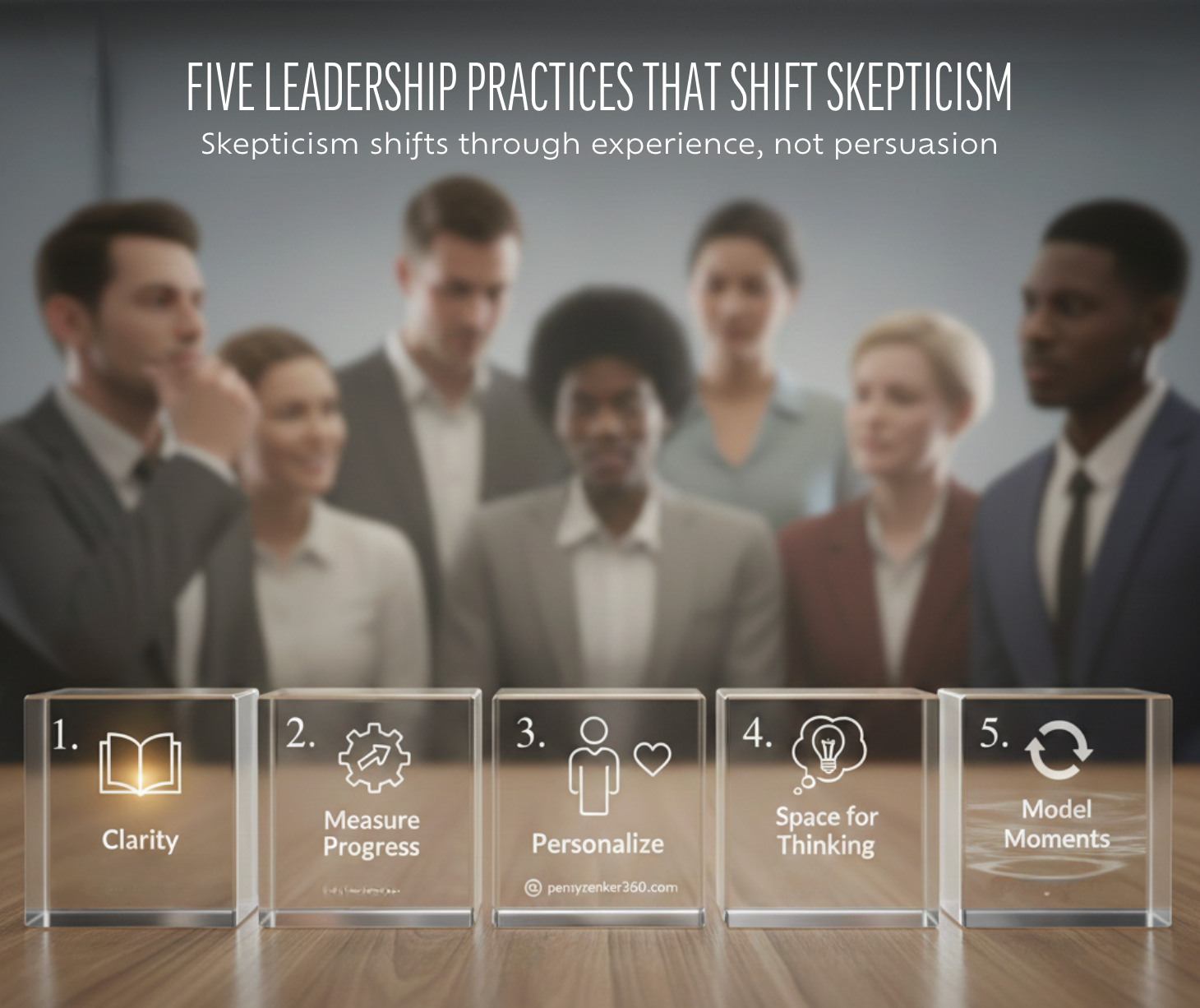
Five Leadership Practices That Shift Skepticism
Experience, not persuasion, changes skepticism. The following practices help because they send new signals to both the brain and the person.
1. Replace Performance Theater with Clarity
Clarity reduClarity makes things easier to process. When people know what’s expected and how success is measured, their brains stop looking for hidden risks.n cognitive load theory shows that uncertainty increases mental strain and reduces higher-order thinking
https://link.springer.com/article/10.1007/BF00375165
When leaders explain why they make certain decisions or use certain metrics, people don’t have to guess. Guessing is tiring, but clarity brings energy back.
2. Measure Progress, Not Just Activity
Our brains naturally look for progress. Seeing real movement forward boosts motivation and helps people stick with things.
Research on motivation and progress by Teresa Amabile highlights how meaningful progress fuels engagement more effectively than pressure or incentives
https://hbr.org/2011/05/the-power-of-small-wins
Progress shows our brains that effort is worthwhile.
3. Personalize the Employee Experience
Personalizing the experience helps people feel safe and like they belong. This is reinforced by Penny Zenker’s proprietary research on personalization and employee experience, which shows how individualized signals increase trust, engagement, and discretionary effort. You can explore the full findings here:
https://pennyzenker360.com/new-era-of-persoanlization-study/
4. Create Space for Thinking, Not Just Output
When people feel safe, they can think more clearly and creatively. Research by Amy Edmondson demonstrates that when people feel safe to think out loud, learning and performance improve
https://hbr.org/2019/11/what-is-psychological-safety
5. Model Reset Moments as a Leadership Practice
Reset Moments breaks the habit of always being on guard. When leaders pause to ask what’s working, what needs to change, and what matters most, they lower stress and help people start learning again.
Over time, Reset Moments help people focus less on threats and more on possibilities. This naturally rebuilds trust and engagement.
Reframing Skepticism as Information
Skepticism is not a flaw. Skepticism isn’t a flaw; it’s a source of information.ty feels missing, where trust has thinned, or where effort has not reliably translated into impact. Leaders who listen to skepticism gain insight into the employee experience. Leaders who ignore it allow it to deepen.
The goal is not elimination. It is a transformation.
Healthy skepticism helps performance, but constant skepticism wears it down.
Changing the Signal Changes the Outcome
The most important lesson in the shell game story is not about deception. It is about attention.
One moment, trained focus toward protection. Repetition reinforced that pattern. Life unfolded through a defensive lens.
Workplaces work in a similar way.
Leaders change outcomes by changing signals. Through clarity, presence, and consistency, they help people reset focus. When focus shifts, thinking opens. When thinking opens, engagement returns.
People invest where trust feels real.
They engage where their thinking matters.
They contribute when things are clear, not confusing.
This is how skepticism fades, and lasting engagement comes back.
About the author:
Penny Zenker, The Focusologist, is an international keynote speaker, 2x best-selling, award-winning author, and top podcast host. A former tech entrepreneur and turnaround specialist, she helps leaders and organizations navigate complexity through focus, adaptability, and human-centered performance.
Ask me anything for FREE for 7 days on Fuel.io
(Affiliate disclosure: This link is an affiliate link. If you choose to explore it, you may earn a small commission. It doesn’t affect your cost and helps support free educational content.)
Cluster FAQs
1. Why is skepticism increasing in today’s workplace?
Skepticism rises when experience teaches people that effort does not reliably lead to impact. Repeated misalignment between promises and outcomes trains focus toward protection. The full guide explains how leadership signals reshape this pattern over time.
2. How does skepticism affect focus and engagement?
Skepticism narrows attention and shifts energy toward self-protection. This reduces initiative and ownership. Engagement improves when leaders send signals that restore clarity and psychological safety. The complete resource explains this neurological shift.
3. Is skepticism the same as resistance?
No. Skepticism is cautious attention shaped by experience. Resistance is behavioral. Leaders who understand the difference respond with clarity instead of pressure. The full guide shows how this distinction changes outcomes.
4. What role does clarity play in reducing skepticism?
Clarity removes the need for guessing. Guessing increases vigilance. Clear direction restores cognitive capacity and trust. The full guide explains why clarity consistently correlates with engagement.
5. Why do metrics sometimes increase skepticism?
Metrics backfire when they feel performative or disconnected from meaning. The brain interprets this as surveillance. Measuring progress instead of activity changes that signal. The complete resource explains how.
6. How does personalization rebuild trust?
Personalization signals that people are seen as individuals. This activates trust circuits and reduces self-protection. The full guide explains how small personalized moments reshape engagement.
7. What does neuroscience reveal about skeptical behavior?
Skepticism activates the amygdala and reduces access to higher-order thinking. Leaders shift this by creating clarity, safety, and consistency. The full guide details how this happens.
8. How can leaders tell if skepticism is present?
Skepticism shows up quietly through withheld ideas, guarded feedback, and delayed commitment. The complete resource explains how to notice these patterns early.
9. Why does recognition sometimes fall flat?
Recognition fails when it feels generic or misaligned. The nervous system detects insincerity quickly. Personal relevance restores credibility. The full guide explains how.
10. How do Reset Moments reduce skepticism?
Reset Moments interrupts defensive patterns and redirects attention toward learning. Over time, they retrain focus and rebuild belief. The complete resource shows how to use them consistently.
11. What creates psychological safety for skeptical employees?
Consistency, clarity, and transparency reduce perceived risk. When people understand intent, they re-engage their thinking. The full guide outlines how leaders build safety through signals.
12. How does skepticism affect feedback?
Low safety makes feedback feel risky. Curiosity-based feedback reframes it as collaboration. The complete resource explains how this shifts participation.
13. Can trust be rebuilt once skepticism sets in?
Yes, through repeated alignment between words and actions. Credibility precedes belief. The full guide explains this progression.
14. How does meaning influence skepticism?
Meaning reinforces the belief that effort matters. When meaning is unclear, skepticism grows. The complete resource connects meaning to engagement.
15. Where should leaders start?
Start with clarity that removes guesswork, progress that restores momentum, and personalization that signals belonging. The full guide details how to begin.
Quote Bank
- Skepticism is learned attention, not attitude.
- Focus follows experience.
- Clarity calms the nervous system.
- People protect what feels uncertain.
- Progress restores belief.
- Trust grows through alignment, not reassurance.
- Engagement reflects belief, not compliance.
- Meaning sustains effort when pressure rises.
- Presence is a leadership signal.
- Personalization reduces protection.
- Thinking requires psychological safety.
- Reset Moments retrain attention.
- Consistency builds credibility.
- Skepticism softens when experience changes.
- Leaders shape culture one signal at a time.