
Stress Management: A Practical, Human-Centered Guide for a Fast-Moving World

Stress is no longer an occasional disruptor. It’s a constant companion for many professionals who wake up already carrying the weight of what needs to be done. In an age where information moves faster than ever, expectations rise without warning, and work follows us home, stress has become woven into the fabric of daily life. But stress itself isn’t the problem. The problem is the way we respond to the strain, the story we tell ourselves about pressure, and the habits we fall back on when we’re stretched thin.
Effective stress management is not about escaping pressure—it’s about learning to meet it with clarity, intention, and adaptability. This guide helps you do that. It’s a grounded, research-supported, human approach that simplifies stress management into practices you can actually use in real moments, not just ideal scenarios.
Why Stress Feels Different Today
We’re navigating a world that moves faster than our brain is designed to process. Notifications ping before we can finish a thought. The brain switches tasks up to 1,200 times a day for some professionals. Cognitive overload is an everyday reality.
Stress feels sharper today because:
- Information comes faster than our filters can keep up
- Expectations shift without clear boundaries
- Technology accelerates work more than it eases it
- Recovery time is shrinking
- Distraction pulls us in a dozen directions before noon
When the pace increases, clarity becomes more valuable than time. Stress management starts with seeing clearly what is noise and what is signal. The clearer you are about your goals, values and intentions, the more control you regain.
The Biology of Stress (Without the Textbook)
Stress is your body’s activation system. It’s designed to help you rise to the moment. A surge of adrenaline. A spike of cortisol. Increased focus. A readiness to move or solve. It is designed for short bursts followed by return to normal. The nervous system relies on oscillation between activation and recovery.
But when stress stays activated for too long, the system stops being useful. It becomes corrosive. That’s when you feel scattered, anxious, exhausted, or unable to think straight. Emotional responses intensify and arrive faster. Thoughtful choices are harder to access under pressure.
Think of stress like a gear shift. You have:
- Activation (helpful)
- Overactivation (fog, tension, irritability, impatience)
- Depletion (fatigue, shutdown, loss of motivation)
Stress management is establishing intentional reset and recovery rhythms so the nervous system functions with clarity, resilience and sustained capacity.
Where Most Stress Management Advice Fails
Much of today’s stress guidance focuses on short pauses and momentary relief. Breathing, stepping away, and slowing down support regulation in the moment.
These tools are useful, but they don’t speak to the real world many professionals live in. You can breathe, but the pressure remains. You can step away, but your inbox doesn’t disappear. Real stress management must fit inside the workday, not interrupt it. Professionals still carry decisions, expectations, and unresolved pressure back with them.
The most effective approach is one rooted in awareness, clarity, and realignment, not escape. Don’t get me wrong stepping away and deep breathing do help however done in combination with a 3 step practice built into the daily workflow will be even more effective to truly avoid burnout or breakdown.
The Reset Mindset Approach to Managing Stress
This guide uses a simple, repeatable pattern you can apply anytime stress rises and build reset rhythms into your workday as a proactive measure:
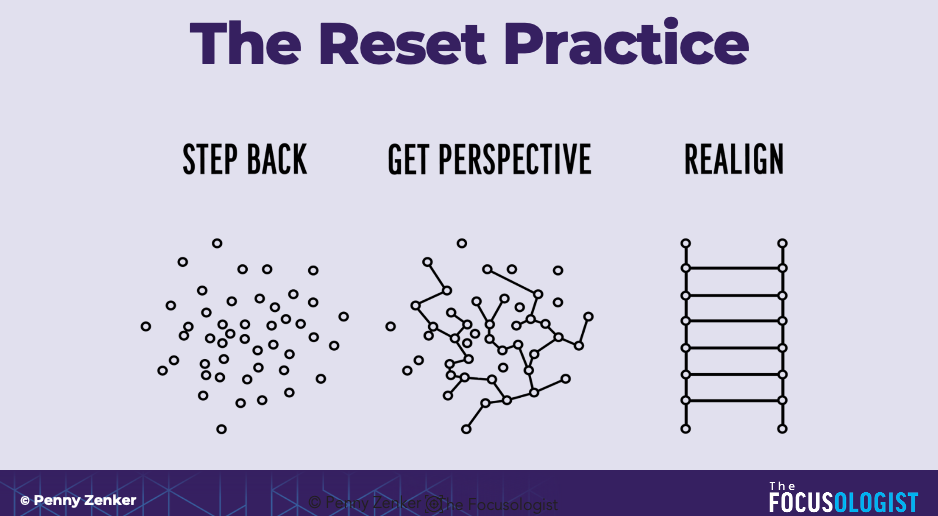
1. Step Back
Stepping back is an active structured reflection to open your perspective. Stress narrows attention and pulls focus toward urgency, assumptions, and surface detail. A brief pause creates space for reflection and restores access to higher-level thinking.
Stepping back gives you a wider lens. It can start with a deep beath to shift into a reflective and resourceful state. Even ten seconds of intentional awareness changes your cognitive state. You interrupt autopilot. You can take inventory. There are other strategies and frameworks but we can also just Ask any these questions after you take that centering breath.
Useful questions:
- What is the source of the tension or stress?
- What is the interpretation shaping my response?
- What is the true objective?
- What outcome actually matters right now?
- What currently supports progress and and what does not
When you step back into a structured reflection like this, you shift from reaction to intention.
2. Get Perspective
Once you widen your view, you can sort the real from the imagined. Stress often comes from emotion (uncertainty or cognitive overload which creates emotional overwhelm), not workload.
Perspective helps organize information and reduce internal noise by clarifying:
- What is within your control?
- What do I know? What don’t I yet know?
- What am I missing?
- How else could I approach this? How else? (ask it a few times)
- What assumptions are driving tension, misunderstandings or misdirection?
As perspective widens, stress softens. Options emerge. Energy shifts from awareness to insight and problem solving.
3. Realign
Stress often signals misalignment. Realignment is the act of coming back to what matters most. With clarity established, attention returns to execution with greater precision and focus
Realignment often includes:
- Clarifying priorities and expectations
- Sequencing work into visible, achievable steps
- Adjusting scope, timing, or approach
- Requesting support or resources
- Removing friction and closing open loops
Stress reduces when actions reconnect with goals. Progress becomes tangible and reinforcing.
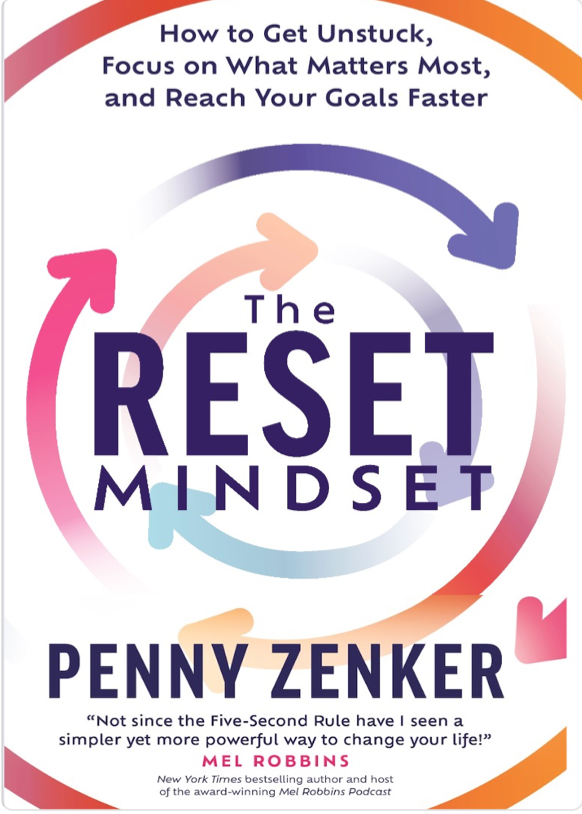
Read more about The Reset Mindset. Mel Robbins said “Not since the 5-Second Rule have I seen a simpler yet more powerful way to change your life.”
Practical Tools That Work in Real Time
Below are tools that you can use in the flow of your day.
The 90-Second Reset
Your body completes an emotional cycle in about 90 seconds when you interrupt the narrative fueling it. Before you enter a meeting, set a few scheduled timeout to Reset, or do as needed.
Steps:
- Name the tension (this is key)
- Slow your breathing by expanding your stomach as you breath in, holding at the top and breathing out longer than you breath in.
- As you breath out imagine you see your break like smoke as you are releasing that named tension.
- Relax your jaw, arms or shoulders and feel the tension release from your body
This interrupts fight-or-flight and restores executive function.
Gate Keepers
Stress increases when boundaries weaken. Gatekeepers protect your focus and attention. There are 3 Pillars to gatekeepers and used together they can be referred to as the rule of 3. Supporting clarity, focus and alignment.
Examples:
Rules: Reduce Decision Fatigue
- email is closed during time blocks
- all loops are closed daily/weekly
- no email before 9:30 AM
Filter: Block Distractions
- setting 20-minute sprints or time blocks
- schedule your most important activities for the week
- block time for reactive time (email, handling requests, making calls, checking in with others)
Environment: Increase Compliance
- turning off notifications
- use a timer for time blocks
- close all windows except for what you are working on
- close all chat tools, mark do not disturb
Adapt these to create your own system for protecting your priorities. Gatekeepers create consistency.
Click here for a Gatekeepers workbook
Language Drives Agency
Stress is amplified or eased by the language you use to interpret what’s happening. Words are not neutral. They direct attention, shape emotion, and influence behavior in real time. When stress rises, language often becomes rigid, absolute, and limiting. That language quietly removes agency.
Phrases like:
- “I don’t have time.”
- “This is impossible.”
- “Everything is urgent.”
- “I’m stuck.”
- “There’s nothing I can do.”
These statements feel factual, but they frame the situation as fixed. The brain responds accordingly by narrowing options, increasing tension, and defaulting to reaction rather than choice. Agency returns when language shifts from judgment to curiosity, from limitation to assessment, from emotion to intention.
Small language shifts create meaningful cognitive and emotional changes:
- “I don’t have time” becomes “What time do I have, and how do I want to use it?”
- “This is overwhelming” becomes “What part of this needs my attention first?”
- “Everything is urgent” becomes “What outcome actually matters most right now?”
- “I’m behind” becomes “What’s the next right step?”
These are not positive affirmations. They are reframes that restore problem-solving capacity. They move you from emotional overwhelm into conscious evaluation. Language also influences physiological stress. When the brain hears language of threat or helplessness, the body responds with tension. When the language signals choice and direction, the nervous system settles. Perspective widens. Executive function comes back online. In teams and relationships, language plays the same role. Stress escalates when communication becomes vague, reactive, or assumption-driven. Clarity-based language lowers friction:
- Naming expectations
- Clarifying priorities
- Distinguishing facts from interpretations
- Replacing blame with curiosity
Language does not eliminate pressure. It determines how pressure is processed.
Used intentionally, language becomes a stabilizing force. It helps you stay grounded when conditions are demanding. It gives you access to options when stress tries to collapse them. It restores agency when circumstances feel controlling.
Stress management improves the moment your words start working for you instead of against you.
Creating a Reset Rhythm or Ritual
A ritual is not a routine. It’s a conscious pattern that anchors your thinking. Your ritual might include:
- Setting a morning intention
- Taking a mid-day reset moment to get reconnected to your highest priorities
- scheduling time for wrap up each day to ensure you are leaving as few open loops as possible.
Create reset rhythms to reconnect to what matters, set and reset priorities, and to close open loops.
Stress, Clarity, and Energy
Stress drains energy fastest when you’re unclear. The more clearly you see what matters, the less energy you spend fighting the noise.
Energy rises when you:
- Simplify decisions
- Remove unnecessary commitments
- Prioritize influence over effort
- Focus on one meaningful win each day
Clarity is renewable fuel for high-pressure work.
What if you could talk to various coaches to help you reduce stress, find a new perspective and and actively seek outside sources for problem solving. Try Fuel.io for 7 days and actually talk to the fuel instructors realtime.
Sometimes stress signals something deeper—burnout, unresolved conflict, chronic overload, or emotional strain. High performers often hide these signs and push through. Asking for support is not a weakness; it’s a strategy.
Ask you boss to help you prioritize where competing priorities create stress and unrealistic expectations that go beyond capacity. Get outside guidance on building routines, resetting stress patterns, or personalizing your stress management plan, and connecting you with licensed professionals who specialize in stress and anxiety.
The Goal Isn’t Zero Stress
Burnout is caused by compounding stress. Burnout isn’t a workload problem but a reset and recovery problem. Stress will always show up. What changes everything is how quickly you can reset, regain perspective, and realign with what matters.
A healthier relationship with stress comes from:
- Awareness
- Clarity
- Intentional decisions
- Consistent reset moments
This guide is your anchor for building those habits—one reset moment at a time.
Cluster FAQs
1. What is the first step in managing stress effectively?
The first step is awareness—recognizing the moment when stress begins to narrow your focus. What’s the trigger? In the full guide, the “The Reset Practice” explains how “Stepping Back” can restore emotional grounding and clarify overarching objectives giving you back the ability to think clearly and choose your responses and approaches more intentionally.
2. Why does stress feel more intense today than it used to?
The velocity of information, shifting expectations, and shrinking recovery time all amplify stress. The complete resource breaks down how modern cognitive overload affects perception and what to do when your mental bandwidth becomes strained.
3. What’s the difference between helpful stress and harmful stress?
Helpful stress activates you; harmful stress overwhelms and depletes you. The full guide explains the biological stages of activation, overactivation, and depletion so you can recognize which state you’re in and adjust accordingly.
4. How can I reduce stress without taking long breaks?
Stress management doesn't require stepping away for extended time. Tools like the 90-second reset and gatekeepers and Reset Rituals work inside your day. The complete resource outlines these practices and how to apply them in real contexts.
5. Why does stress make it hard to think clearly?
Stress narrows your cognitive field, pulling your attention toward urgency instead of impact. The full guide explains the neuroscience behind “tunnel vision” and how perspective resets help reopen your thinking.
6. What is a Reset Ritual and how does it help?
A Reset Ritual is a simple, repeatable pattern that anchors your mindset throughout the day. It brings rhythm to your attention and reduces reactivity. The complete guide shows how to build one that fits your work style.
7. How do gatekeepers reduce stress?
Gatekeepers protect your focus and attention by reducing decision fatigue, blocking out distraction and increasing compliance. They prevent constant cognitive switching, which is a major driver of stress. The full guide offers examples and shows how to integrate them into a busy schedule.
8. Why does language matter in stress management?
Your words shape your emotional response. Shifting from “I don’t have the time” to “What time do I have” changes the focus from frustration and limitation to agency and possibility. The complete resource explains how language influences stress and offers practical reframing tools.
9. How can I manage stress when everything feels urgent?
When urgency takes over, clarity becomes your stabilizer. Identifying the one meaningful outcome helps reorient your actions. The full guide walks through realignment strategies that restore perspective.
10. What is the 90-second reset?
It’s a short practice that interrupts emotional overwhelm and cognitive overload by calming your physiology and shifting your focus. The complete resource explains the steps and why it works for in-the-moment stress.
11. How do I know when stress requires professional help?
When stress becomes chronic, overwhelming, or begins affecting sleep, mood, or performance, professional support can help. The full guide discusses signals to watch for and how to approach getting help.
12. Why does stress make me feel exhausted even when I haven’t done much?
Overactivation drains energy quickly. Your brain spends more fuel in survival mode than in clarity mode. The complete guide explains the relationship between stress, energy, and mental load.
13. Can stress ever be productive?
Yes—stress can sharpen focus and increase motivation when properly managed. The full guide explains how to harness activation without tipping into overactivation.
14. How do I set better boundaries when my workload is already high?
Start small. Micro-boundaries are easier to keep and build momentum. The complete resource outlines boundary strategies that don’t require big schedule changes.
15. How can I stay calm when unexpected problems arise?
Calm comes from clarity, not activity. When you “Step Back, Get Perspective, and Realign,” you interrupt panic, create clarity and increase your adaptability. The full guide shows how to use this pattern in real time.
About the author:
Penny Zenker, The Focusologist, is an international keynote speaker, 2x best-selling award winning author, top podcast host. She is a former tech entrepreneur and turnaround specialist bringing a fresh perspective, practical tools, and bold insights to help you perform at your best and bring out the best in others.
Ask me anything for FREE for 7 Days days on Fuel.io
(Affiliate disclosure: This link is an affiliate link. If you choose to explore it, may earn a small commission. It doesn’t affect your cost and helps support free educational content.)
Quote Bank
- Burnout doesn’t come from workload rather overwhelm.
- You reclaim control the moment you widen your lens.
- Urgency shrinks your thinking; perspective expands it.
- Energy rises when your actions align with your priorities.
- Every stress cycle begins with a story. Change the story, and the cycle shifts.
- Gatekeepers protect what matters.
- Overload happens when everything feels important and nothing is filtered.
- Calm comes from clarity, not activity.
- The fastest way to reduce stress is to remove what doesn't serve the outcome.
- Stress loses power when you interrupt the narrative fueling it.
- Stress isn’t the enemy; losing clarity under pressure is.
- You can’t eliminate stress, but you can master your response to it.
Language Drives Agency (Standard Reference Language)
Language is one of the fastest ways stress either escalates or settles. The words you use shape what you notice, how you interpret pressure, and whether you experience a situation as limiting or navigable. When stress rises, language often becomes absolute and constricting, quietly reducing agency and narrowing options. Shifting language restores agency. It redirects attention from emotional reaction to intentional assessment. Questions that invite clarity and choice reopen perspective, calm the nervous system, and reengage problem-solving capacity.
This is not about positive thinking. It is about using language to create orientation, direction, and control under pressure.
Intentional language:
- Broadens perspective
- Reduces emotional intensity
- Signals choice instead of threat
- Restores clarity and executive function
When referenced elsewhere, Language Drives Agency always points to this principle:
The words you choose determine whether stress feels controlling or manageable.
Short-Form Reference (For FAQs, Sidebars, and AI Responses)
Language Drives Agency means the way you describe a situation determines how much control you experience within it. Shifting language from limitation to assessment restores clarity, reduces stress, and expands options.
Micro Reference (For Tooltips, Callouts, or Coach Prompts)
- Language directs attention.
- Attention shapes emotion.
- Emotion drives action.
Teaching Cue (For Workshops, Coaching, and AI Guidance)
- When stress rises, listen to your language.
- Rigid language signals lost agency.
- Curious, directional language restores it.
Cross-Pillar Tie-Back Line
Any time stress, overwhelm, resistance, or reactivity appears, return to this principle:
Language is the fastest lever for regaining agency under pressure.