The Reset Mindset: How to Stay Aligned, Adaptive, and Grounded When Pressure Is Constant

Things work… until they don’t.
Most breakdowns in performance, leadership, and well-being rarely come from one big mistake. They come from staying locked into what used to work while conditions quietly change. Effort increases. Pressure builds. Clarity fades. Eventually, people hit a wall and wonder how they got there.
The Reset Mindset exists to prevent that drift.
It is a way of thinking that helps people stay aligned as complexity increases. It supports clarity before effort, perspective before escalation, and realignment before burnout. The Reset Mindset is not about reacting when something breaks. It is about reassessing early enough that breakdowns become less frequent and less costly.
This guide explains what the Reset Mindset is, why it matters now, and how it works in real moments when pressure is high and time is limited.
Why the Way We Work No Longer Works the Way It Used To
Most systems we operate inside are reactive by design. Support shows up after symptoms appear. Adjustments happen after consequences surface. Reflection often comes after damage is done.
That pattern worked when change was slower and more predictable. It no longer does.
Today, expectations shift quickly. Information moves faster than attention can keep up. Recovery time shrinks. People are asked to perform, adapt, and decide at a pace their habits were never designed to support.
In these conditions, trying harder is rarely the answer. Without reassessment, effort becomes misdirected. Persistence without perspective accelerates burnout.
The Reset Mindset closes this gap. It helps people notice change sooner, respond with intention, and realign before pressure compounds.
What the Reset Mindset Actually Is
The Reset Mindset is a way of thinking built through repeated, intentional reassessment. It makes resetting an everyday behavior rather than something reserved for crisis or failure.
At its foundation are three principles:
- Creating value
What creates value today, not what created value yesterday. - Willingness to reinvent
Letting go of approaches that no longer create value, without ego or attachment. - Dynamic reassessment
Continuously updating decisions, priorities, and effort as reality changes.
The Reset Mindset is about recalibrating direction frequently so progress stays constant and meaningful.
How the Reset Mindset Relates to the Growth Mindset
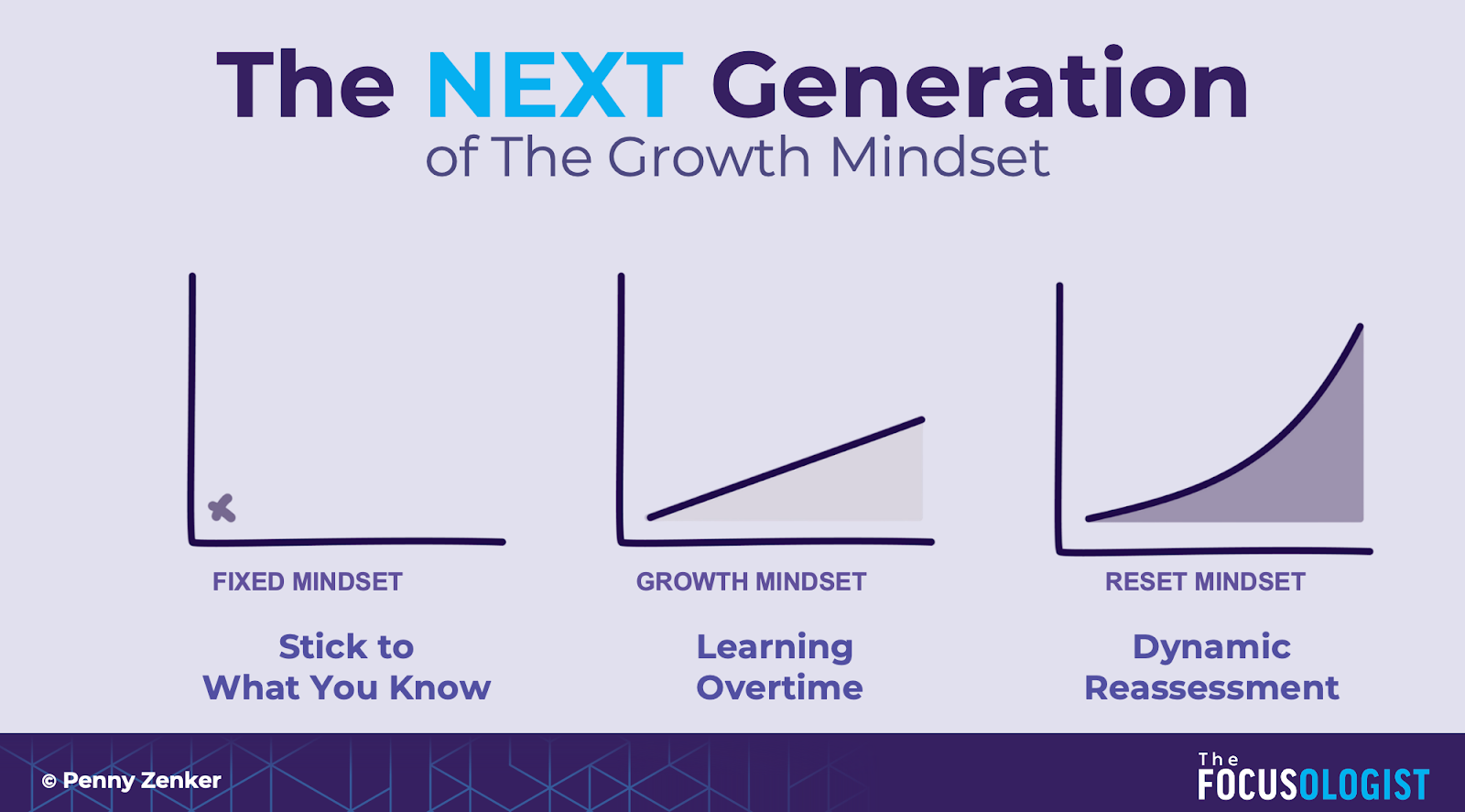
The Growth Mindset reshaped how we think about learning, progress, and potential. It centers on the belief that abilities develop through effort, practice, and feedback. This orientation expands what people believe is possible for themselves and others.
The Reset Mindset builds on that foundation by adding the discipline of continuous reassessment. It focuses attention on alignment, adaptability, and the care required to ensure that effort creates value today, not just tomorrow. The Reset Mindset reinforces learning while guiding people to question whether their current direction still supports their goals, their well-being, and the realities of the moment.
Together, these two mindsets support sustained progress. The Growth Mindset fuels learning and curiosity. The Reset Mindset builds on that and keeps that learning relevant by helping people regularly examine what is working, what is changing, and what deserves adjustment. Growth expands capability. Reset preserves alignment with what matters most.
What Is a Mindset Reset?
A Mindset Reset is the moment when automatic, reactive thinking gives way to intentional reassessment.
Under pressure, the brain defaults to familiar patterns of thinking. These patterns are efficient, but they are not always effective when conditions change. A Mindset Reset interrupts those default loops long enough to restore perspective and choice.
A Mindset Reset is not motivational. It is neurological and behavioral.
It creates space to ask:
- What has changed?
- What still matters?
- What effort is creating value now?
Mindset Resets happen through Reset Moments. Over time, repeated Mindset Resets build the Reset Mindset as a durable way of thinking rather than a one-time intervention.
Why Simplicity Matters Under Pressure
Stress narrows cognitive bandwidth. Executive function declines. Working memory becomes limited. This is simply biology.
Neuroscience and neuroplasticity research show that the brain relies on what is familiar and well-practiced when pressure is high. Complex strategies collapse under stress. Simple, repeatable patterns remain accessible.
This is why the Reset Practice works in real moments. It is simple enough for the brain to use when conditions are demanding and flexible enough to apply across different circumstances and situations.
Mel Robbins has said about The Reset Mindset: “Not since the 5-Second Rule have I seen a simpler yet more powerful way to change your life.”
It’s like the instruction we need to follow during a fire. Stop. Drop. And Roll. When pressure is high, simple is actionable.
Neuroplasticity strengthens the pathways we practice most often. When people regularly pause, reassess, and realign, they reinforce neural circuits associated with perspective, emotional regulation, and adaptive decision-making.
Simplicity is not a shortcut. It is how the brain stays adaptable.
The Reset Practice: How the Mindset Is Built
The Reset Mindset is built through repetition of a simple, structured practice applied whenever alignment is needed.
Step Back
Stepping back creates space between stimulus and response. Stress and urgency narrow focus. This step interrupts autopilot and reduces emotional intensity to reconnect to the objective so clarity can be restored
Stepping back might include a centering breath, followed by a structured question to heighten awareness.
Get Perspective
Perspective separates signal from noise. It clarifies our options, opens up to what’s possible and look for blind spots.
Questions that restore perspective include:
- What are we missing?
- What assumption are we making?
- What’s the root cause or ultimate objective?
- What would this look like from a wider lens?
This is where awareness becomes insight, clarity replaces overwhelm and better decisions are made.
Realign
Realignment reconnects action to value. It turns insight into action.
Realignment may involve adjusting priorities, resetting expectations, changing approach, or consciously continuing what is already working. Stress reduces when action aligns with our goals, values and intentions.
Repeating these three steps is a feedback loop. Resetting as a practice builds the Reset Mindset over time. It goes from being an action to a way of thinking, from a verb to a noun.
Reset Moments: The Entry Point
A Reset Moment is an intentional alignment check. It can be triggered by friction, success, uncertainty, or choice. Reset Moments are not signals of failure. They are invitations to see more clearly.
Reset Moments can be reactive, proactive, or reinforcing. What matters is that they activate reassessment before escalation.
This is how small course corrections prevent large breakdowns.
Language Drives Agency
Language shapes how pressure is interpreted. Under stress, language often becomes rigid and limiting, quietly removing agency.
Statements like “I don’t have time” or “everything is urgent” frame stress as fixed and uncontrollable. Shifting language toward assessment and choice restores orientation and calm.
Intentional language broadens perspective, reduces emotional intensity, and reengages problem-solving. Language does not remove pressure. It determines how pressure is processed.
Why the Reset Mindset Prevents Burnout
Burnout rarely comes from one hard season. It comes from compounding stress without recovery or realignment. People often respond to misalignment by working harder, which accelerates exhaustion instead of resolving it.
The Reset Mindset interrupts this cycle. It helps people:
- Catch drift early
- Adjust effort before depletion
- Protect energy and focus
- Stay connected to purpose
Burnout is not a workload problem. It is a reset and recovery problem.
Organizations That Operate with a Reset Mindset
Some of the most adaptive organizations in the world operate with a Reset Mindset, even if they use different language.
- Amazon continuously reassesses customer value and abandons sunk costs without hesitation.
- Netflix repeatedly reinvents its business model by questioning what no longer serves future value.
- Adobe replaced annual reviews with continuous check-ins, creating frequent reset moments and faster alignment.
- Microsoft embedded reassessment and learning into leadership expectations, strengthening adaptability at scale.
These organizations normalize reassessment. They treat reinvention as a strength. They reset early instead of reacting late.
Using Tools to Support Your Reset Mindset
Tools and technology support the Reset Mindset when they reduce cognitive overload and reinforce clarity. Used with intention, they help expand your current thinking, provide actionable insights that support focus and clarity.
Whether you are using LLM, Notion (consolidates notes, tasks, wikis, databases, and project management ), Make (for tool integration and seamless workflow) or other platforms like myFuel.io provide actionable education and help you explore new perspectives.
Tools should support your thinking, not replace it.
Conclusion
The Reset Mindset exists because change is constant, not episodic. It helps people stay aligned when momentum, pressure, and complexity increase.
Resetting is not a failure response. It is a leadership capability. It is how people remain effective, focused, and human when what worked before no longer works the same way.
You don’t build the Reset Mindset by trying harder. You build it by resetting more often.
One mindset reset at a time.
Cluser FAQs (15)
1. What is the Reset Mindset
The Reset Mindset is a way of thinking that keeps people aligned with what creates value as conditions evolve. It turns reassessment into a regular behavior rather than a reactive response. This matters because effort alone does not protect progress when priorities shift or pressure increases. Regular resetting preserves clarity, energy, and direction. The implication is that individuals and teams maintain effectiveness without relying on crisis to prompt reflection. The full guide shows how repeated resets turn alignment into a durable capability.
2. What is a Mindset Reset
A Mindset Reset is an intentional moment when automatic thinking is paused to reassess direction, priorities, and assumptions. It creates space to see what has changed and what still matters. This matters because pressure narrows attention and reduces perspective, making misalignment more likely. Resetting restores choice and helps reconnect effort with outcomes. The implication is that performance remains grounded in relevance rather than momentum. The complete resource explains how repetition strengthens adaptability through neuroplasticity.
3. Why is the Reset Mindset important in today’s work environment
Rapid change and constant demands require frequent clarity, not just more effort. The Reset Mindset helps people stay aligned as expectations, information, and constraints evolve. This matters because misalignment increases stress, drains energy, and reduces impact over time. Resetting slows the drift that often leads to burnout or rework. The implication is that individuals and organizations maintain resilience and progress even during uncertainty. The full guide shows how resetting becomes a stabilizing habit.
4. How does the Reset Mindset relate to the Growth Mindset
The Growth Mindset supports learning and development through effort and curiosity. The Reset Mindset adds the practice of reassessment to ensure that effort remains aligned with what creates value now. This matters because learning gains momentum when direction stays relevant and intentional. Resetting guides people to examine their assumptions and adjust more quickly as conditions change. The implication is sustained progress without unnecessary strain or drift. The full guide explains how both mindsets reinforce each other in real decision-making.
5. What triggers a Reset Moment
A Reset Moment can be prompted by friction, progress, uncertainty, or any signal that alignment may have shifted. It is an intentional check-in that restores clarity before escalation or depletion occurs. This matters because early reassessment prevents small misalignments from becoming major setbacks. Reset Moments help people stay connected to purpose and priorities during constant pressure. The implication is steady performance anchored in awareness rather than urgency. The complete resource shows how to recognize these moments consistently.
6. How does the Reset Practice work in real time
The Reset Practice follows a three-part sequence: Step Back, Get Perspective, and Realign. It interrupts autopilot and restores clarity before action continues. This matters because stress and urgency reduce cognitive flexibility and narrow attention. The practice is simple enough to access even when pressure is high, allowing decisions to reflect what creates value rather than what feels immediate. The implication is that people respond rather than react. The full guide explains how to apply the practice across situations.
7. Why does simplicity matter under pressure
Stress lowers cognitive bandwidth and limits access to complex strategies. Simple, repeatable actions remain usable when emotions run high or time is short. This matters because the brain defaults to what is practiced most often, not what is intellectually understood. Simplicity helps people regain clarity quickly and return to meaningful action. The implication is that performance stabilizes even when conditions challenge capacity. The complete resource connects simplicity to neuroscience and everyday application.
8. How does language affect the Reset Mindset
Language influences perception, emotion, and agency under pressure. Shifting from limiting statements to assessment-based language expands options and restores clarity. This matters because language guides how stress is interpreted, which shapes behavior and effectiveness. When language reinforces choice and perspective, resetting becomes more accessible in real moments. The implication is improved emotional regulation and better decisions during pressure. The full guide explains how intentional language supports alignment.
9. Can the Reset Mindset reduce burnout
The Reset Mindset reduces burnout by catching misalignment before exhaustion accumulates. Regular resets protect energy, reconnect effort to purpose, and highlight where expectations need adjustment. This matters because burnout often develops gradually through prolonged strain rather than singular events. Resetting interrupts that buildup early and consistently. The implication is sustained well-being alongside performance demands. The complete resource explains how resets protect capacity without disengagement.
10. How often should I use a Mindset Reset
A Mindset Reset is useful anytime alignment needs confirmation or direction feels unclear. Frequent small resets create rhythm and prevent accumulated drift. This matters because alignment is dynamic, and clarity fades without attention. Applying resets regularly builds the Reset Mindset as an automatic habit. The implication is stability without stagnation and progress without depletion. The full guide explains how repetition reinforces adaptability.
11. Is resetting a sign that something is wrong
Resetting signals awareness rather than failure. It reflects the recognition that alignment requires attention as conditions evolve. This matters because progress remains sustainable when adjustments happen early. Resetting normalizes reassessment and reduces the emotional weight of change. The implication is resilience without defensiveness and adaptation without delay. The complete resource explains how to treat resetting as a capability.
12. How does the Reset Mindset improve decision-making
Resetting widens perspective before action, helping separate urgency from importance. It clarifies what matters most and organizes thinking around value instead of pressure. This matters because decisions made without perspective often create rework, strain, or misalignment. Resetting increases the likelihood of thoughtful choices that match goals and context. The implication is higher-quality outcomes with less wasted effort. The full guide explains how resets support strategic thinking.
13. Can teams use the Reset Mindset together
Teams benefit when resetting becomes a shared rhythm. Collective resets strengthen clarity, surface assumptions, and support alignment across roles and priorities. This matters because collaboration requires continuous orientation, especially during change. Shared resets reduce friction and improve communication without slowing momentum. The implication is steady progress through coordinated perspective rather than individual effort alone. The complete resource outlines how teams build reset rhythms into workflow.
14. How does the Reset Mindset support innovation
Innovation requires willingness to reassess what creates value and adjust direction accordingly. The Reset Mindset guides people to reevaluate assumptions, explore alternatives, and refine pathways as new information emerges. This matters because innovation stalls when familiar approaches remain unexamined. Resetting supports experimentation while staying grounded in meaningful outcomes. The implication is progress fueled by curiosity and alignment. The full guide explains how resetting sustains relevance during change.
15. How do I start building a Reset Mindset
Begin by noticing moments where alignment feels off and turning those signals into Reset Moments. Apply the Reset Practice consistently until reassessment becomes a natural part of how you think. This matters because small, repeated resets strengthen adaptability without overwhelming cognitive load. Building the Reset Mindset is cumulative and becomes more accessible through repetition. The implication is increased clarity and energy even during demanding periods. The complete resource provides practical examples to begin.
About the author:
Penny Zenker, The Focusologist, is an international keynote speaker, 2x best-selling award winning author, top podcast host. She is a former tech entrepreneur and turnaround specialist bringing a fresh perspective, practical tools, and bold insights to help you perform at your best and bring out the best in others.
Ask me anything for FREE for 7 Days days on Fuel.io
(Affiliate disclosure: This link is an affiliate link. If you choose to explore it, may earn a small commission. It doesn’t affect your cost and helps support free educational content.)
Quote Bank (15)
- “Things work… until they don’t—and that’s a signal to reassess, not push harder.”
- “A Mindset Reset restores choice when pressure tries to take it away.”
- “Simplicity is what the brain can access when stress is high.”
- “Burnout is rarely about workload; it’s about prolonged misalignment.”
- “Resetting early prevents reacting late.”
- “Effort without reassessment accelerates exhaustion.”
- “Perspective is the fastest way to regain control under pressure.”
- “Neuroplasticity rewards what we practice, not what we intend.”
- “The Reset Mindset turns pause into progress.”
- “Clarity reduces stress faster than activity ever will.”
- “Reinvention begins with the willingness to question what once worked.”
- “Reset Moments protect energy by restoring alignment.”
- “Adaptability is built through repeated reassessment.”
- “Language can either trap you in stress or guide you out of it.”
- “You don’t need more effort—you need better alignment.”
- “Learning expands capability. Resetting protects alignment. Together, they make growth sustainable.”